Worldmark | July 2, 2026

Why Global Business Districts Are Replacing Business Parks
The future of commercial real estate is no longer about standalone office buildings. It is about integrated ecosystems where work, hospitality, retail, connectivity and public spaces come together in one place. Across the world, the business parks are giving way to something far more ambitious: the Global Business District.
From Business Parks to Global Business Districts
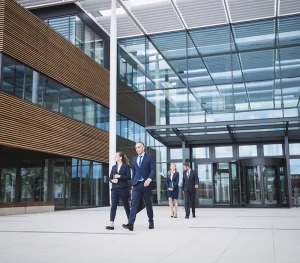
Business parks were built for a simpler idea of work. Rows of office blocks, a shared parking lot and perhaps a canteen were enough to house a workforce that arrived at nine and left at six. But work has changed, and so have the people who do it. Today’s professionals expect more from the places they spend their days in. They want convenience, culture and connection woven into their environment, not tacked on as an afterthought.
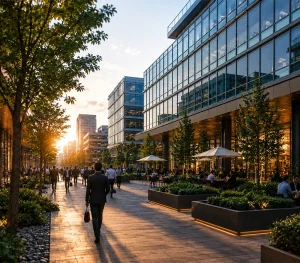
Global Business Districts answer that expectation. Instead of isolating offices from everything else, they blend them with hotels, restaurants, retail streets, wellness spaces and open plazas. The result is a living, breathing environment rather than a static workplace. This shift sits at the heart of the future of workplace thinking, where the office is one part of a much larger experience.
Why Leading Companies Choose Ecosystems
The world’s most forward-looking companies are choosing ecosystems. An address in a vibrant district signals ambition, helps attract talent and keeps teams energised. When employees can meet a client over lunch, host an evening event, or step out for a walk without leaving the campus, the workplace becomes a genuine asset rather than a cost line.
This is why mixed-use developments create stronger business communities. Proximity breeds collaboration. Startups sit alongside global giants, retailers serve daily footfall, and hospitality venues turn a district into a destination that stays alive well beyond office hours.
Hospitality, Retail and Culture as Magnets
Hospitality, retail and culture are no longer supporting acts. They are the reasons global businesses put down roots. A well-run hotel makes hosting visitors effortless. A curated retail street gives daily life a rhythm. Cultural spaces and events give a district its identity and its soul. Together, they explain why businesses today invest in environments, not just infrastructure. Companies are buying into an atmosphere, a reputation and a way of working that a plain office block could never offer.
Worldmark Aerocity: A Blueprint for the Future
Nowhere is this evolution clearer than at Worldmark, Aerocity in New Delhi. Spread across roughly 17 million square feet, it stands as a true Global Business District and one of India’s largest mixed-use commercial ecosystems. Here, integrated offices sit alongside World St., a lively hospitality and retail promenade, along with public spaces designed for people to gather, dine and connect.
Worldmark, Aerocity captures exactly what the future of the workplace should feel like. It is not a cluster of buildings but a complete environment, close to the airport and the city, where global businesses can operate, host and grow without stepping outside the district. The seamless blend of commerce, culture and connectivity makes it a natural home for companies that measure their address by experience, not just floor plates.
The Takeaway
The message for occupiers and investors is simple. The value of a workplace now lies in the ecosystem around it. Business parks served their era, but the future of the workplace belongs to integrated districts. As destinations like Worldmark, Aerocity show, the smartest businesses are choosing environments that work as hard as the people inside them.